Valorant Champions Shanghai Group Stage Day 7
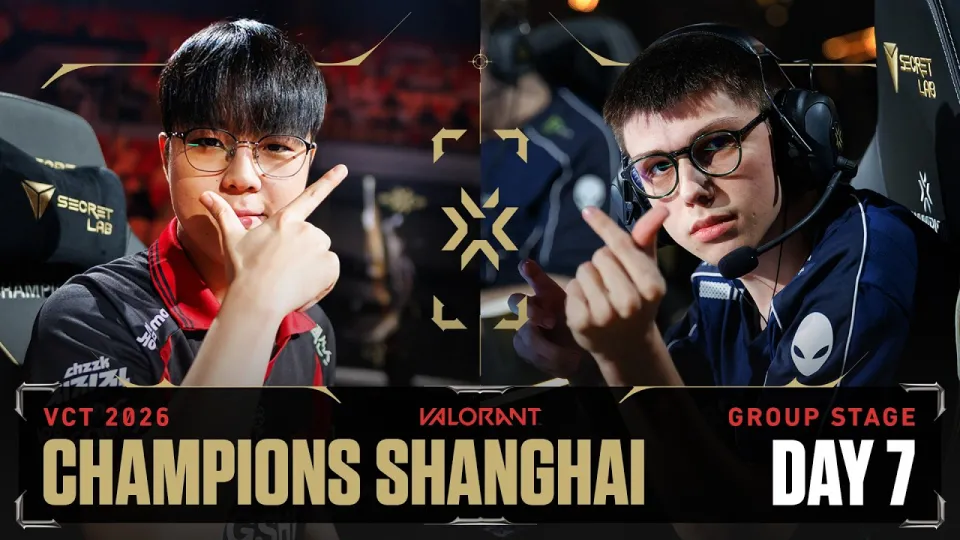
Video: VALORANT Champions Shanghai — Group Stage — Day 7
Need articles like this for your video? They help promote it on YouTube and Google — order them in the Telegram bot @sat_sit_bot. It writes articles around your video, embeds the video and publishes them on popular niche websites (no ads). Try it free: 50 articles on us.
· based on the channel VALORANT Champions Tour
Key takeaways
- Valorant Champions Shanghai runs September 24 to October 18, with 16 teams from Americas, CN, EMEA and Pacific.
- Day 7 of the group stage is the seventh broadcast day of the tournament, streamed by the VALORANT Champions Tour channel.
- The 2026 season already produced two different Masters champions, so Shanghai decides the year's biggest trophy.
- Viewers flagged repeated technical pauses during the Day 7 broadcast, disrupting map flow and round momentum.
- CN representatives drew heavy criticism for losing eco rounds and 5v2 situations once set plays broke down.
Valorant is Riot Games' free-to-play 5v5 tactical shooter, and at the top level it is defined by the VALORANT Champions Tour, whose 2026 world final runs in Shanghai from September 24 to October 18. Day 7 of the group stage, broadcast on the VALORANT Champions Tour channel, narrowed the field for sixteen teams from Americas, CN, EMEA and Pacific. For schedules, brackets and live updates, the official esports account at VALORANT Esports on X is the fastest source.
What the Valorant Champions Shanghai format actually is
Valorant Champions Shanghai is the season-ending world championship, and the group stage is where sixteen qualified teams are cut down before the playoff bracket. The event window set by the organizer spans September 24 to October 18, which leaves roughly three and a half weeks for groups, playoffs and the grand final. Qualification is regional: Americas, CN, EMEA and Pacific each send representatives based on their 2026 VCT circuit results.
The group stage exists to sort seeding and eliminate the weakest records, so Day 7 sits deep enough into the schedule that teams are fighting for survival rather than experimenting. That matters for how the matches read on broadcast: drafts get more conservative, pistol rounds carry disproportionate weight, and a single lost eco can decide a series.
Why the 2026 season makes Shanghai different
The 2026 VCT season broke the assumption that one region owns the international meta. Two Masters events produced two different champions, and the official event description frames Shanghai as the moment when "familiar names, new contenders, and a fearless generation of challengers" converge. In practice that means the group stage is less predictable than in previous years: teams that looked dominant in regional play have arrived with holes in their map pools.
The result is a Day 7 slate where established organizations can no longer coast on reputation. A best-of-three loss in groups can flip a seed and force a brutal playoff path, and the broadcast spends real time on the bracket math because of it.
Technical pauses and broadcast rhythm on Day 7
Technical pauses were the loudest story of the Day 7 broadcast, and viewers noticed them piling up across the stream. A pause freezes the round clock, resets communication tempo and forces casters to fill dead air, and repeated stoppages compound: players cool down, coaches get extra time to talk, and momentum built over several rounds evaporates.
For anyone watching a VOD rather than the live feed, the practical takeaway is simple: expect gaps, and treat the round clock as unreliable when judging a team's pace. The production team also flagged that timestamp-based spoiler guides needed editing precisely because pauses shifted the timeline.
The CN question after a rough group stage
The harshest criticism on Day 7 targeted the CN representatives, and the specific complaints were technical rather than emotional. Observers pointed to lost eco rounds, blown 5v2 advantages and a lack of creativity in utility usage once prepared strategies stopped working. That pattern — strong structure, fragile improvisation — is the classic failure mode for teams whose set plays are scouted in a long group stage.
A second thread argued that stronger teams from other regions missed the event entirely, which inflates the perceived gap between CN and the rest. Both points can be true at once: the format rewards regional depth, and a region's third seed is not automatically better than another region's fifth.
How to read a group stage VOD like an analyst
Watching a Day 7 broadcast back is more useful when you watch for structure instead of highlights. A repeatable method:
- Pick one team and track their pistol-round setup across all maps — the same five-man execute usually appears with small variations.
- Note every eco or half-buy loss and check whether the loss came from utility mismanagement or from a duel lost in isolation.
- Watch the first two rounds after each technical pause; teams often revert to a default they trust rather than the plan they had been running.
- Log which agent compositions appear on each map, because pick rates in a long tournament reveal what coaches consider reliable under pressure.
- Compare post-plant positioning between halves — the team that adjusts usually wins the map, not the team that starts faster.
This is also the fastest way to learn Valorant as a player: the pro broadcast is a free library of default setups, retake angles and utility lineups that transfer directly to ranked play.
Viewer questions that came out of the broadcast
The most common viewer confusion around Day 7 was about pauses, and the honest answer is that a broadcast pause is a production and server issue, not a gameplay decision. Long pauses are normal in a multi-week LAN with sixteen teams, and they are usually resolved by administrators rather than players.
A second recurring question was whether a single group-stage collapse means a region is weak. It does not — group stages are small samples, and a team that loses two eco rounds in a row can still win the tournament. The more reliable signal is how a team responds after a timeout or a pause, which is visible in the VOD if you know where to look.
Useful links
- Official esports news and event info: https://www.valorantesports.com
- Live and VOD streams on Twitch: https://www.twitch.tv/valorant
- Social updates on X: https://x.com/valorantesports
- Facebook: https://www.facebook.com/ValorantEsports/
- Instagram: https://www.instagram.com/valorantesports/
- TikTok: https://www.tiktok.com/@valorantesports
Final verdict on the Shanghai group stage
Day 7 of Valorant Champions Shanghai clarified more than it settled: the format is doing its job by punishing shallow map pools, and the pause-heavy broadcast is a production problem rather than a competitive one. The CN results are a real warning about improvisation under pressure, but the sample is still small enough that playoff runs remain possible. This analysis is based on the VALORANT Champions Tour broadcast, and following the official VALORANT Esports account on X is the simplest way to catch bracket updates, schedules and stream links before the next match day.
Source: VALORANT Champions Shanghai — Group Stage — Day 7 · Markdown version
Questions & answers
What is the Valorant Champions Shanghai group stage?
It is the opening phase of the 2026 VALORANT world championship, where sixteen teams from Americas, CN, EMEA and Pacific play to earn playoff seeds and avoid elimination. The event runs from September 24 to October 18, with the group stage occupying the first portion of the schedule.
Why were there so many technical pauses on Day 7?
Pauses in a multi-week LAN broadcast come from server, hardware or production issues and are handled by tournament administrators, not by the players. They stretch the runtime and disrupt round momentum, which is why VOD viewers often notice a shifted timeline compared with the live round clock.
Did the CN teams really underperform in groups?
Viewers highlighted lost eco rounds, blown 5v2 situations and predictable utility usage once set strategies were scouted. That is a legitimate structural concern, but a group stage is a small sample and does not by itself prove a region is weak.
How can I watch or rewatch the matches?
The VALORANT Champions Tour channel publishes full broadcast VODs, and live streams run on the official Twitch channel at https://www.twitch.tv/valorant. Schedules, brackets and news are posted at https://www.valorantesports.com and on the official X account.